5 Website Mistakes That Cost Home Improvement Companies Revenue
Many home improvement companies assume that if leads are slowing down, they need to spend more on marketing. More Google Ads. More SEO. More social media. More direct mail. While generating demand is important, there's another question worth asking first:
Is your website converting the opportunities you're already creating?
Your website sits at the center of every marketing investment. Whether a homeowner discovers your company through a Google search, a paid advertisement, a referral, or a social media post, your website is often where they decide whether to contact you or move on to a competitor.
The problem is that many contractor websites unintentionally create friction throughout the customer journey. They make it harder for homeowners to find information, build trust, and take action. If your website isn't supporting conversions, every marketing dollar has to work harder to produce the same results.
Here are five of the most common website mistakes that cost home improvement companies revenue:
1. Your Service Area Isn't Immediately Clear
When homeowners land on your website, one of their first questions is:
Do you work in my area?
If visitors can't quickly determine whether you serve their city, county, or neighborhood, many won't spend time searching for answers. They'll simply return to the search results and contact another company. This issue is especially common among contractors who serve multiple markets but list their service areas only on a single contact page.
Your service area should be visible throughout the website, including:
The homepage
Primary service pages
Page headers and footers
Location-specific landing pages
Contact pages
Clear service area messaging not only helps homeowners self-qualify but also strengthens your local search visibility and supports long-term SEO performance.
The easier it is for homeowners to confirm they're in the right place, the more qualified opportunities you'll create.
2. You're Making It Too Difficult to Contact You
Homeowners don't want to work for a quote. If someone is ready to schedule a consultation or request an estimate, every extra click, scroll, or search creates friction. Unfortunately, many contractor websites hide phone numbers, bury contact forms, or force users to navigate multiple pages before they can take action. A high-performing website makes it effortless to contact your company.
That means:
A visible phone number on every page
Click-to-call functionality on mobile devices
Contact forms that are easy to find
Clear calls-to-action throughout the website
Multiple ways for homeowners to connect
Some homeowners prefer to call immediately. Others would rather fill out a form after hours. The best websites accommodate both. Remember, your competitors are only one click away. When contacting your company feels difficult, homeowners often move on rather than push through.
3. Your Calls-to-Action Don't Give Homeowners a Reason to Act
Many contractor websites rely on generic buttons like:
Learn More
Contact Us
Submit
Get Started
While these phrases aren't necessarily wrong, they don't always communicate value. Homeowners want to know what happens next and why it's worth taking action. Compare these two examples:
[Learn More]
versus
[Schedule Your Free Design Consultation]
One is vague. The other communicates a clear next step and a specific benefit. Strong calls to action should answer three questions:
What am I getting?
What happens next?
Why should I do this now?
Pages on your website should guide visitors toward a logical next action. If homeowners aren't sure where to go or what to do after reading a page, your website may be leaving revenue on the table.
4. You're Asking Homeowners to Trust You Without Providing Proof
Home improvement projects are significant investments. Before homeowners invite a company into their home or commit thousands of dollars to a project, they need confidence that they're making the right decision. Yet many websites spend more time talking about themselves than proving why they're trustworthy.
The most effective contractor websites build credibility throughout the customer journey by incorporating trust signals directly into the experience. This includes:
Customer reviews
Before-and-after project galleries
Financing options
Manufacturer certifications
Industry awards
Warranties and guarantees
Team photos and company history
One of the biggest mistakes contractors make is forcing homeowners to leave the website to verify their reputation. Every time a prospect leaves your site to search for reviews, compare competitors, or look for proof, there's a chance they won't come back. High-converting websites bring trust signals directly into the conversion journey so homeowners can find the information they need without leaving the page. Your experience and trust signals are also working behind the scenes to prove relevance in AI searches.
Trust reduces uncertainty, and less uncertainty leads to more appointments.
5. Your Website Is Slow
Website speed isn't just a technical metric. It's a business metric. Homeowners expect websites to load quickly, especially on mobile devices. When pages are slow, visitors become frustrated and leave before they ever see your message.
A slow website can impact:
Conversion rates
Lead volume
Search visibility
User experience
Paid advertising performance
For companies investing in Google Ads, website speed can have an even greater impact. Faster websites often create better user experiences, which can contribute to stronger campaign performance and help maximize advertising budgets. The reality is simple: homeowners won't wait around for a slow website.
As mobile usage continues to grow, speed has become one of the most important factors influencing how prospects interact with your brand online. If your website takes several seconds to load, you're likely losing opportunities before the conversation even starts.
Why Leading Home Improvement Companies Are Rethinking Their Websites
For years, many contractor websites were built like digital brochures—launch the site, leave it alone for several years, then invest in a costly redesign when it starts feeling outdated. The problem is that homeowner expectations, search behavior, and marketing performance don't stand still.
The most successful home improvement companies take a different approach. Instead of treating their website as a one-time project, they view it as an ongoing growth platform that evolves alongside their business. That means continuously improving:
Conversion paths
Mobile experiences
Site speed
Trust signals
Landing page performance
User behavior insights
Small improvements made consistently over time often create a greater impact than a complete redesign every few years. At Truvolv, we believe your website should serve as the foundation for every marketing effort, not just a destination for traffic. Whether a homeowner finds your company through SEO, paid advertising, social media, or a referral, the website should support the entire customer journey and help turn interest into measurable business growth.
Learn more about our exclusive headless CMS (Content Management System), TruSpeed, built for home improvement and home service companies.
Recent Posts
Automatically Generate Image Alt Text
New Modern Footer Layout
Automatic Landing Page Generation
Automatic Lead Form Creation
Many home improvement companies assume that if leads are slowing down, they need to spend more on marketing. More Google Ads. More SEO. More social media. More direct mail. While generating demand is important, there's another question worth asking first:
Is your website converting the opportunities you're already creating?

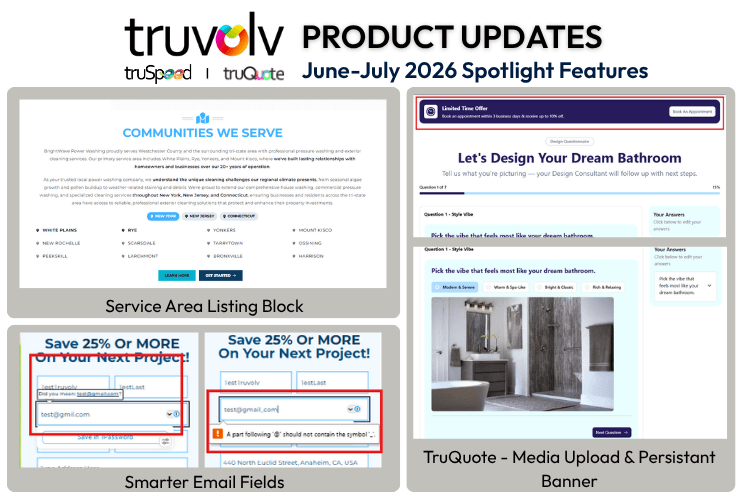
Smarter Email Fields
New "Service Areas Listing" Block
Adding Media Uploads to Questions (TruQuote)
Offer Banners Across Calculator Steps (TruQuote)