The Acronym Trap: Why SEO Still Matters in the Age of AI
You’ve probably heard some version of this in the last six months on a webinar, in a LinkedIn post, or from a sales rep pitching a new AI tool: "SEO is dead. You need GEO now. You need AEO. The old playbook is gone." It’s a great line because it creates urgency, sells software and consulting, and scares contractors into thinking that the strategies that have been generating leads for their business suddenly no longer work.
But that narrative is wrong.
The businesses gaining visibility in ChatGPT, Gemini, and Google’s AI Overviews are overwhelmingly the same ones that were already winning in traditional search. While the playing field is changing, the game remains largely the same. Companies with strong authority, strong reviews, clear positioning, and strong local relevance are still the ones surfacing most consistently across the search environment.
That doesn’t mean AI search is fake or unimportant. It means the conversation around it has become disconnected from how homeowners actually search for and hire contractors today. To understand where search is really heading, you have to move past the hype and look at what the data actually shows.
The 30-Second Summary for the Busy Business Owner
AI is absolutely changing the search landscape, but it still represents a relatively small percentage (roughly 5% to 6%) of overall search activity. More importantly, the majority of revenue-driving home improvement searches still occur through traditional Google search experiences, especially local “near me” queries tied directly to hiring intent.
That distinction matters because AI Overviews primarily appear on informational searches like “bathroom remodel cost” or “how long does window replacement take?” The local transactional searches that actually drive phone calls, quote requests, and booked appointments still rely heavily on traditional local SEO signals like reviews, authority, and Google Business Profile strength.
If you only take away a few things from this article, make it these:
AI search is growing, but Google still dominates where most contractors generate leads and revenue.
AI Overviews primarily impact informational searches, not the local hiring searches that drive phone calls and quote requests.
The businesses winning visibility in AI search are largely the same businesses already performing well in Google.
Strong authority signals like backlinks, citations, reviews, and broader online trust still matter far more than most AI-specific “optimization hacks.”
Clear positioning is becoming increasingly important because AI systems reward businesses that clearly communicate who they serve and what they specialize in.
“Full-service home improvement” tells AI very little, while “bath remodels in Indianapolis” creates far stronger topical relevance and clearer lead alignment.
The companies that win over the next several years will not be the ones chasing every new acronym. They will be the businesses building strong authority, trust, and visibility across every search surface homeowners use.
Understanding the Alphabet Soup: SEO, AEO, and GEO
To understand the shift, you have to understand the three different ways homeowners are now finding you. While agencies pitch these as separate services, they are actually three layers of the same trust-building process:
SEO (Search Engine Optimization): This is the classic foundation of your digital presence. It is the strategy used to ensure your business appears in Google’s standard search results (the list of websites) and the Map Pack (the local map with three business listings and "Call" buttons). Despite the rise of AI, traditional SEO remains the primary engine that makes your phone ring today.
AEO (Answer Engine Optimization): This is the layer focused on Google's answer surfaces, most notably the AI Overviews (AI-generated summaries placed above traditional Google search results), as well as featured snippets and People Also Ask boxes. AEO is the art of ensuring that when a homeowner searches a question like "how much does a roof cost in Wisconsin," your content is the passage Google extracts and cites inside that AI summary. The goal is to be the answer on the results page, even if the homeowner never clicks through to your site.
GEO (Generative Engine Optimization): This shifts the focus toward AI chatbots like ChatGPT, Claude, Gemini, and Perplexity. GEO is the art of ensuring that when a homeowner asks one of these tools for a recommendation, like "Who is the best kitchen remodeler in Indianapolis?" - your business is the one the AI names as a trusted option. Unlike AEO, which optimizes a specific page for extraction, GEO optimizes your broader brand presence across the web (reviews, directories, mentions, your own site) so the AI has consistent signals to draw on when it recommends you.
The industry often treats these as separate silos, but the data shows they are an evolution of the same foundation. Whether a homeowner is scrolling through Google or chatting with a bot, they are looking for a business they can trust, and the signals that prove that trust haven't changed.
The Shift Is Real. The Hype Is Not.
Yes, AI search is growing. No, it isn't replacing the search that drives your leads. The more useful question for your business isn't "how big is AI?" It's "where do AI Overviews actually fire?"
The answer matters. A 2026 analysis found AI Overviews trigger on roughly 36 percent of informational queries, but only 5 percent of transactional ones. Separate industry tracking shows they appear in just 7 percent of direct local queries, such as "plumber near me" or "bathroom remodeler open now."
Translation: "bathroom remodel cost" gets an AI Overview. "Bathroom remodeler near me" doesn't. The queries that bring you actual revenue still resolve through ads, the Map Pack, and ten blue links, with minimal AI interference. Local SEO isn't a legacy tactic to wind down. It's still the engine.
Quick caveat for the people who like to live on the edge of new developments: Google is testing a hybrid SERP for some regional queries like "bathroom remodeler in Michigan." It's an AI-generated answer with brand citations at the top, followed by a curated map of top-rated providers pulled straight from the Map Pack. In other words, Google is starting to fuse Google Business Profile data with AI Overviews for these regional searches. It's early and not widely deployed. But it reinforces, not undermines, the case for treating your GBP as one of your most important assets. Local search isn't going away. It's getting woven into AI.
Busting the "AI Secret Sauce" Myths
OppAlerts conducted one of the most rigorous AI visibility studies in the home improvement industry to date, analyzing 340 home services websites across the plumbing, HVAC, and remodeling sectors. Their goal was simple: identify what actually influences whether an AI platform recommends a business.
The findings challenge the idea that there’s a hidden "AI optimization" trick. Instead, the factors that matter most are the same signals that have driven online visibility for years.
The strongest predictor of AI visibility was overall website authority, often measured through PageRank. In other words, businesses that the broader web views as trustworthy are more likely to be surfaced by AI systems.
Closely behind were backlink-related signals, including both the number of websites linking to a business and the quality of those links. AI models appear to favor companies that are referenced and validated by other credible sources online.
The study also found that businesses with strong web connectivity—measured by factors such as harmonic centrality and links to other trusted websites—were more likely to be recommended. These signals help establish a company's place within the broader online ecosystem.
Traditional search performance remains important as well. Businesses that rank highly in Google, appear frequently in search results, and maintain a strong presence in large web indexes like Common Crawl tend to have greater visibility in AI-generated recommendations.
The takeaway? AI isn't rewarding a secret formula. It's reinforcing the same trust signals that have long influenced search engines: authority, credibility, relevance, and a strong online presence.
This data also allows us to debunk two of the most common pitches in the industry today 0 schema markup and massive content volume:
The Schema Myth: While most agencies pitch schema as the AI unlock, a test of 1,885 pages showed adding schema produced no meaningful lift in AI citations. Major AI systems like ChatGPT and Gemini were found to ignore JSON-LD entirely, reading only the visible HTML content on the page.
The Blog Trap: Piling on blog posts is the most common move in the industry, but it is largely a waste if your foundation is weak, especially on the queries that drive revenue.
We tested this directly. We ran 100 AI-generated queries focused on transactional, buyer-intent searches across two contractors in the same vertical and market size. One had roughly 300 blog posts. The other had about 20 highly specific service pages. On those revenue-driving queries, the 300-blog site was cited 7 times. The 20-page site was cited 57 times.
This isn't a knock on blogs as a category. Blogs get cited all the time, just for informational queries like "how long does a bathroom remodel take?" or "what are the signs of a failing roof?" Those citations come with two problems. AI Overviews increasingly absorb the click before it reaches your site, and on the rare occasions when it does, the visitor is in research mode, not buying mode. The impressions you’re getting look exciting. But the pipeline doesn't move.
How You Actually Win in Search: Personas and Specialization
Instead of chasing "hacks," you win in the AI era by being the "clear choice" for specific homeowner personas. AI recommendations shift dramatically based on who is asking, which provides a massive opportunity for local contractors to compete:
Eco-minded upgraders get recommendations for energy-efficiency brands and energy-credentialed companies.
Aging-in-place planners surface professional associations such as NARI and NAHB, as well as resources from Certified Aging-in-Place Specialists.
High-end renovators surface premium, craftsmanship-oriented remodelers and design-build firms.
You don’t need national authority to appear in these recommendations; you need clear topical relevance for the specific audience you want to attract. Clarity and specialization win every time, while vague generalist positioning remains invisible.
The Truvolv Playbook for AI Search
To turn this diagnosis into a prescription, we recommend focusing on a few high-leverage areas. The good news is that the businesses performing well in AI search are usually the same businesses already building strong authority, trust, and visibility in traditional search.
That means the goal is not chasing AI “hacks.” It’s strengthening the signals that consistently influence visibility across every search environment.
Focus on the Fundamentals That Still Drive Visibility
AI systems still rely heavily on traditional trust signals to determine which businesses are legitimate and worth surfacing. The strongest signals continue to include:
Strong backlinks and domain authority that reinforce your business’s overall credibility online
Consistent business directory citations that validate your location, services, and legitimacy across the web
Positive Google reviews and reputation signals that demonstrate trust and customer satisfaction
Clear local relevance and service-area consistency across your digital presence
Third-party validation through certifications, manufacturer partnerships, and industry organizations
That’s why foundational platforms still matter so much. Directories and platforms such as the Better Business Bureau, Angi, Houzz, Yelp, and manufacturer dealer locators, as well as organizations like NARI, NAHB, and NKBA, all contribute to your broader online authority profile. AI systems crawl these sources to validate trust, service relevance, and consistency over time.
Treat Your Google Business Profile Like a Core Asset
Your Google Business Profile remains one of the highest-leverage local marketing assets your business owns. In both the Map Pack and AI-driven recommendations, review signals often outweigh the quality of your website itself.
Strong visibility is heavily influenced by:
Review quantity, which helps establish market trust and legitimacy
Review recency, which signals that your business is active and consistently delivering projects
Strong star ratings that reinforce customer satisfaction and service quality
Consistent review responses that demonstrate engagement and professionalism
Accurate business information and updated service-area details
Real project photography that helps validate credibility and workmanship
The contractors gaining the most visibility are not occasionally asking for reviews. They are building review generation into every completed project and treating reputation management like an ongoing operational priority.
Clarity Wins While Vague Positioning Loses
AI systems reward businesses that clearly communicate who they serve, what they specialize in, and what types of projects they handle best.
That includes clearly defining:
The core services your company specializes in
The geographic areas you actively serve
The types of homeowners or projects you are best equipped to handle
The differentiators that separate your business from competitors in your market
“Full-service home improvement” tells AI very little. “Bath remodels in Indianapolis” creates much stronger topical relevance and clearer lead alignment.
The same principle applies to content strategy. Fewer, stronger pages consistently outperform large libraries of generic SEO content when they:
Answer real homeowner questions clearly and directly
Showcase completed projects and real-world expertise
Explain pricing, timelines, and remodeling processes transparently
Demonstrate authority through educational, experience-driven content
Start Tracking AI Visibility Now
AI referral traffic may still be relatively small today, but that will not remain true forever. Contractors should begin monitoring:
AI referral traffic inside GA4
Citation patterns across AI-driven platforms
Brand mentions within AI-generated responses
Emerging shifts in homeowner search behavior
Platforms like Semrush’s AI Toolkit can help businesses better understand how they are appearing across emerging AI-driven search environments before the competition catches up.
The Bigger Picture
SEO, AEO, and GEO are not separate strategies. They are the same fundamentals of trust and authority applied to more surfaces. Whether it’s Google ranking your business or ChatGPT recommending it, the question remains: Does the internet trust this company enough to recommend it?
If you want to see how your business is performing across traditional search and AI surfaces, your Truvolv team can run an AI visibility audit alongside your regular reporting. Reach out to your account manager to get on the list.
Recent Posts
Automatically Generate Image Alt Text
New Modern Footer Layout
Automatic Landing Page Generation
Automatic Lead Form Creation
Many home improvement companies assume that if leads are slowing down, they need to spend more on marketing. More Google Ads. More SEO. More social media. More direct mail. While generating demand is important, there's another question worth asking first:
Is your website converting the opportunities you're already creating?

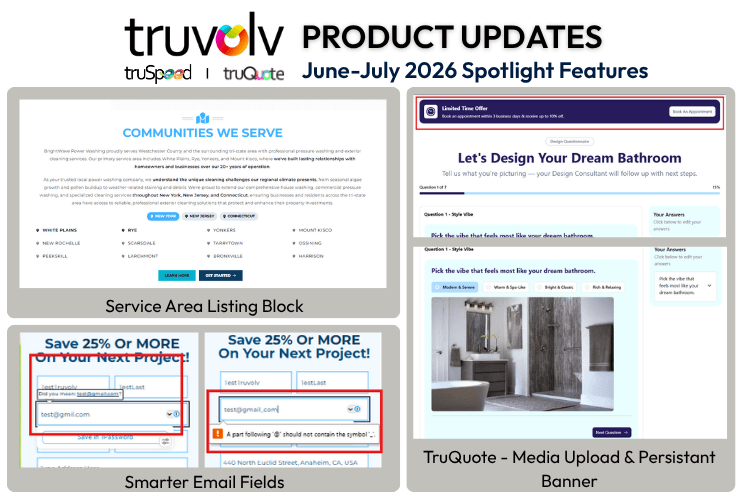
Smarter Email Fields
New "Service Areas Listing" Block
Adding Media Uploads to Questions (TruQuote)
Offer Banners Across Calculator Steps (TruQuote)