How Googlebot Accesses Your Website And Why Structure Still Matters for SEO
Google’s documentation explains that Googlebot has a specific limit that affects how it processes pages and resources during crawling:
“When crawling for Google Search, Googlebot crawls the first 2 MB of a supported file type… Each resource referenced in the HTML (such as CSS and JavaScript) is fetched separately, and each resource fetch is bound by the same file size limit.”
— Google Search Central
This sets a clear limit—Googlebot does not process unlimited content from pages or resources. For website owners and marketers, this means how you organize and deliver content and code matters.
Googlebot Processes Files Within a Defined Crawl Boundary
When Googlebot accesses a page, it retrieves the HTML file and each referenced resource separately. Each file is processed within the same crawl size limit.
Googlebot only guarantees it will look at the first part of each file, meaning that content or code that comes later might not be processed the same way.
Placement Within HTML Influences What Crawlers See
Since crawling is limited by file size, where you place important content in your HTML matters. Elements that show up earlier in the document are more likely to be processed, such as:
primary page text
internal links
structured information
navigation elements
Pages will still look normal to users. This difference only affects how crawlers see your site.
Referenced Resources Are Evaluated Separately
Googlebot does not only process HTML. It also retrieves referenced CSS, JavaScript, and other resources individually, each subject to the same size constraint.
Common page resources include:
CSS stylesheets
JavaScript files
fonts and media assets
embedded third-party scripts
Each resource is checked individually, using the same size limit.
Why This Matters for Website Architecture
As pages and their resources grow, the portion that Googlebot can process within its limits becomes more important. This means your HTML structure and how you deliver resources affect how your content is seen during crawling.
This is a structural issue, not a visual one. Search engines only evaluate what they crawl, not everything the browser shows to users.
How TruSpeed Architecture Supports Crawl Efficiency
This principle aligns directly with how TruSpeed websites are built.
TruSpeed uses a headless CMS, which keeps the content system separate from the frontend. This avoids the extra bulk and tight connections found in older CMS setups, making page output more efficient.
TruSpeed also delivers sites via cloud and edge networks, helping assets reach both users and crawlers quickly and efficiently.
All these design choices help support:
clean HTML structure
efficient resource delivery
reduced platform overhead
predictable page composition
These factors help ensure meaningful content sits within the portion of the page Googlebot reliably processes.
The Truvolv Perspective
Googlebot’s crawl boundary reinforces a foundational SEO principle: accessibility and structure influence how search engines interpret content.
Truvolv’s website strategy and TruSpeed platform architecture are intentionally designed around efficient delivery and crawl-friendly structure. That foundation supports both user experience and crawler accessibility.
Search visibility depends on both what’s on your page and how easily a crawler can reach it. With TruSpeed, that accessibility is part of how member websites are built and delivered.
Recent Posts
Many home improvement companies assume that if leads are slowing down, they need to spend more on marketing. More Google Ads. More SEO. More social media. More direct mail. While generating demand is important, there's another question worth asking first:
Is your website converting the opportunities you're already creating?

Smarter Email Fields
New "Service Areas Listing" Block
Adding Media Uploads to Questions (TruQuote)
Offer Banners Across Calculator Steps (TruQuote)

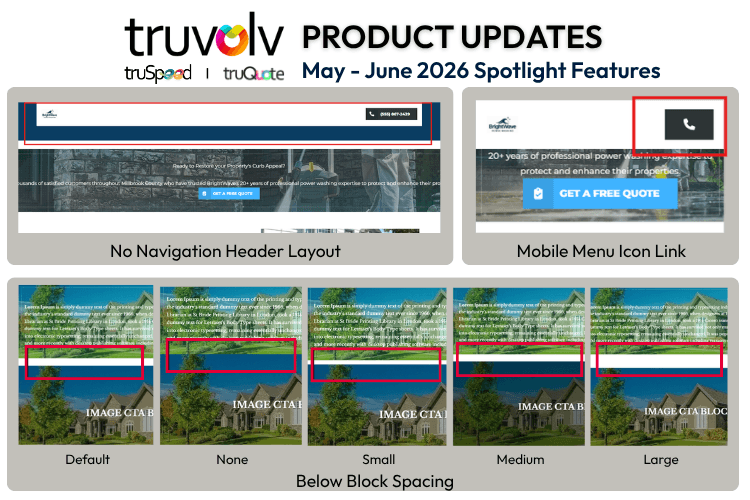
No Navigation Header Layout
Mobile Menu Icon Link
Below Block Spacing (Part 1)
Trash & Version History Expansion (Soft Delete)